Learn · The rules
How to play four-player chess
Four armies share a board. Every player competes for points. Keep your King safe, watch all three opponents, and aim for the highest final score.
This guide explains the free-for-all rules implemented by li4chess. Other four-player variants can score or end games differently. There are no teams here.
Play four-player chessFree, no account needed · Computers or friends on one device
Meet the board and the four armies
The board is a 14-by-14 grid with its four corners cut away, leaving 160 playable squares. Each player starts with the familiar 16 pieces: eight pawns, two Knights, two Bishops, two Rooks, a Queen and a King.
With Red at the bottom, Blue sits on the left, Yellow at the top and Green on the right. Red moves first. Turns go Red → Blue → Yellow → Green, then repeat. Passive, eliminated armies are skipped. A resigned player's automatically moving King is a special case explained below.
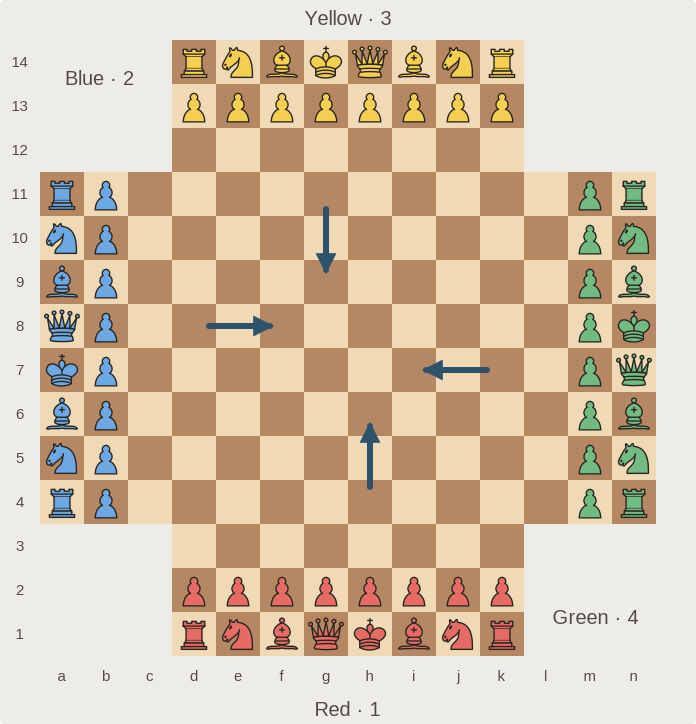
Rooks move along ranks and files, Bishops diagonally, Queens both ways, Kings one square and Knights in an L shape. Knights can jump over pieces; sliding pieces stop at the first occupied square. No piece can enter a cut-out corner.
Pawns move forward toward the center from their own side, capture one square diagonally forward, and may advance two squares on their first move from their starting line if both squares are clear. “Forward” is up for Red, right for Blue, down for Yellow and left for Green.
Score points, then compare the final totals
Capturing a piece from a live army adds points to your score. A piece's capture value is separate from how useful it is on the board.
| Piece | Points |
|---|---|
| Pawn | 1 |
| Knight | 3 |
| Bishop | 5 |
| Rook | 5 |
| Original Queen | 9 |
| Queen promoted from a pawn | 1 |
| Passive piece from an eliminated army | 0 |
Live Kings cannot be captured. When a player is checkmated on their scheduled turn, the active players checking that King split 20 points equally. For example, two checking players receive 10 each. A player who only blocks an escape square receives no share.
Ordinary single checks score nothing by themselves. A move that newly checks two or three active enemy Kings with your army earns a multi-check bonus:
| Newly checked Kings | A Queen gives any of these checks | No Queen gives these checks |
|---|---|---|
| Two | +1 | +5 |
| Three | +5 | +20 |
Already checked Kings do not count as new checks. Discovered checks from your other pieces do count. Capture and multi-check points can add together, with any checkmate award resolved later.
The highest final score wins, even if that player was eliminated. Staying alive gives you more chances to score, but survival alone does not guarantee first place. Equal totals share a place: a tie for first produces places 1, 1, 3, 4.
For a simple capture example, taking a live Bishop and then a live pawn earns 5 + 1 = 6 points. Capturing those same pieces after their army becomes passive earns zero. Open Points history during a game to see where each award came from.
Check, checkmate and the pieces left behind
A legal move must leave your own King safe from every active opponent. You cannot ignore your own check to take a valuable piece elsewhere. The game highlights legal destinations when you select a piece.
Checkmate and stalemate are assessed when the affected player's turn arrives. If Blue checks Red, Yellow and Green still move before Red is assessed. One of them might remove the checking piece or open an escape. Their moves must protect their own Kings; they are not required to rescue Red.
A checked player with no legal move on their turn is checkmated. A player with no legal move while not in check is stalemated. Both armies stay on their squares as passive blockers: they cannot move or attack, and all their pieces, including the King, are worth zero capture points.
Passive pieces still block lines. Removing one may expose your King to another army's Rook, Bishop or Queen, making an apparently easy capture illegal.
Stalemate also has a scoring rule: a self-caused stalemate gives that player +20; an opponent-caused stalemate gives each remaining active player +10. li4chess tracks the move that closed the last legal escape rather than guessing from the final diagram.
Promotion, castling and en passant
Promote on your eighth rank
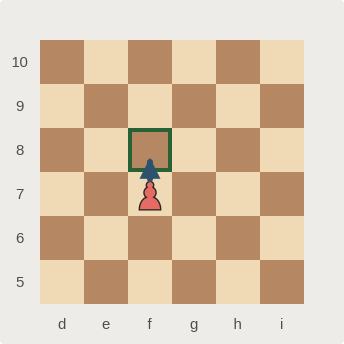
A pawn automatically becomes a Queen when it reaches its own eighth rank. It does not need to cross the whole board. From Red's fixed perspective, Red promotes on rank 8, Blue on file h, Yellow on rank 7 and Green on file g. There is no promotion choice. The new Queen moves like a Queen but is worth only one point if captured while active.
Castle while the route is safe
Castling moves your unmoved King two squares toward its unmoved home Rook and places that Rook on the intervening square. The required spaces must be empty. Your King cannot start in check or cross or land on a square attacked by an active opponent. Moving the King or the relevant Rook loses that right; returning it does not restore it.
En passant waits for your opportunity
After an enemy pawn's two-square advance, your pawn may be eligible to capture it on the square it passed over. The opportunity lasts until your next scheduled turn; intervening opponents' moves do not automatically cancel it. If you choose another move, your opportunity expires. The capture must still leave your King safe, and the double-pushed pawn must still be available to capture.
How a game ends
The third elimination ends normal play and freezes the placements by final points. If live automatically moving Kings remain from earlier resignations or timeouts, the survivor receives +20 for each of them. There is no blanket extra survival award for every already checkmated army.
Resigning while any seat has completed fewer than three moves aborts the game with no normal result. After that opening guard, a resigning player's army becomes passive except for its King. That King makes automatically selected legal moves on its normal turn until it is eliminated; it cannot be captured. The same rules apply to the game's explicit simulated timeout action. Public local games have no running clocks.
With exactly two active players, a leader at least 21 points ahead of the other can use Claim Win. This immediately surrenders the leader's King, gives the other active player +20 and ends the game. Compare all four totals first: a previously eliminated player may still finish above both of you.
Threefold repetition, specified insufficient-material positions, or 200 consecutive individual moves without a pawn move or capture end play automatically. Each active player receives a flat +10; passive and walking-King players receive none. Final totals still decide placements.
Start your first game
- Return to the play page and choose Play against computers. You are Red against three level-3 CPUs.
- Select one of your pieces, then a highlighted destination. On a keyboard, Tab enters the board, arrow keys navigate, Enter or Space selects and moves, and Escape clears your selection.
- Check the turn banner and all four scores after each round. In Customize game, you can choose levels 1–10 or turn CPU control off for friends sharing your device.
Games autosave in this browser when storage is available. Starting a new one replaces the save; export a replay from More game tools first if you want to keep it.
Ready for the next move?
Read the beginner strategy guide for a practical checklist, a capture trap and a way to learn from your games.
Rules checked against li4chess-ffa-standard-v1, November 8, 2026. The full rules specification covers edge cases. Diagrams use engine-validated positions and the credited Cburnett piece artwork.