Learn · Better habits
Four-player chess strategy for beginners
Your move can be legal and still leave a costly surprise three turns later. Begin by widening your view, then let the score guide your decisions.
These are practical starting habits for li4chess free-for-all play, not a proven opening system or a promise of wins. If the scoring is new to you, start with how to play four-player chess.
Try a game1. Think in a full round
In a four-army position, three opponents can move before your next turn. Looking only at the next player misses attacks from the other two sides.
Before you commit, name the opponents in order. As Red, ask what Blue can do, then Yellow, then Green. Start with their checks, captures and immediate threats. You cannot calculate every possible branch, but you can spot an exposed Queen or an open line toward your King.
Repeat that scan after each opponent moves. A pawn that looked like cover may have vanished; a Bishop's diagonal may now reach across the center. Your last plan is a suggestion to reconsider, not an obligation.
A short before-you-move checklist: Is my King safe? What am I leaving undefended? Who can take the piece I am moving? What changes before I move again? What happens to the scores?
2. Check the recapture before taking the points
A capture raises your score immediately, but may hand someone else a larger award and remove one of your strongest pieces. Check defenders from all armies, not just the army you are attacking.
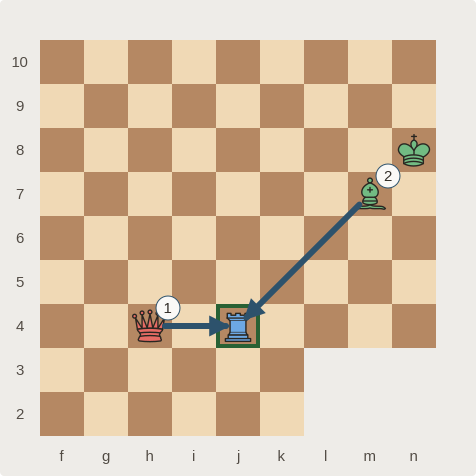
In this example, the sequence is Red Qh4×j4, Blue Ka7–b7, Yellow Kg14–h14, Green Bm7×j4. Red keeps the five points already earned; Green gains nine. Red also loses the Queen's future attacking and defensive power.
That does not prove every Queen-for-Rook capture is bad. The standings, threats and remaining material matter. It does show why “I get points now” is too small a reason on its own.
3. Develop with your King's shelter in mind
In the opening, aim to bring useful pieces into play without removing every pawn in front of your King. A small number of purposeful pawn moves can open routes for Bishops and Knights. Moving the same piece repeatedly to chase a low-value target can leave the rest of your army stuck at home.
The center offers long lines and access to several opponents. It also brings attacks from more directions. Try developing toward useful central squares while keeping support and a route back to safety.
Castling can help arrange your King and Rook, but first look at all three opponents' open lines. A legal castle satisfies the engine's immediate safety checks; it does not promise that the resulting position is easy to defend.
Avoid treating the player opposite you as a teammate. They compete for the same final first place, and a move that helps you now may stop helping on their next turn.
4. Separate a threat from a guaranteed reward
A check does not necessarily become checkmate. The threatened player is assessed on their own scheduled turn, after any intervening players have moved. They might capture the checker, block the line or open an escape.
Before sacrificing a piece for an apparent mate, look through the turn order and ask who can change that position. Also check who would receive the points: active checking owners split the 20-point mate award. Merely filling an escape square does not earn a share.
Multi-checks can score, but ordinary single checks do not award points by themselves. A Queen involved in any of your new checks reduces the two-King bonus to +1 and the three-King bonus to +5; without a Queen among those checking pieces, the bonuses are +5 and +20. Do not expose a valuable piece just to give a check with no follow-up.
5. Notice the promotion race and the passive blockers
Pawns promote on their own eighth rank, close to the center of this larger board. A supported pawn approaching that line may deserve more attention than a distant capture. Count the pawn's remaining legal advances and the opponents who can stop it before your next turn.
A promoted Queen has Queen movement but gives an opponent only one capture point while active. That can make it useful for taking calculated risks, though losing it still costs you a powerful piece.
When an army is checkmated or stalemated, reassess the board. Its pieces no longer attack, but they still block movement. Removing a zero-point piece may open a valuable route; it can also uncover an enemy sliding attack. Avoid spending moves collecting passive pieces just because they are available.
6. Play the standings as well as the position
Final points rank all four players, including those already eliminated. Read the scoreboard whenever an army leaves active play. Staying alive with a low total may still leave you behind.
For example, suppose a passive Red army has 40 points while the two active players have 30 and 8. The 30-point player can claim because the active-player lead is 22. The claim gives the 8-point player +20, ending with 40, 30 and 28 among those three. Red still finishes above both active players. The fourth player's total also remains part of the final ranking.
Before choosing Claim Win, compare the result after the +20 award with every player's score. Before forcing an automatic draw, remember that it adds a flat +10 to each active player and does not erase earlier totals. The best practical choice depends on the whole position; these rules are a way to evaluate it, not a universal instruction to avoid endings.
A manageable practice routine
- Choose one habit. For one game, scan every opponent's captures before each move. For the next, focus on keeping your King sheltered.
- Use a comfortable CPU level. Customize each seat from 1–10. Levels change search budgets; they are not measured chess ratings. Choose a setting that leaves you room to think.
- Find one turning point. Use move history and Points history to identify a costly capture, a missed promotion threat or a shared mate award. Ask what was visible before your decision.
- Keep the game if it helps. Export its replay from More game tools before starting a new game. A replay can restore the saved position and history; there is no move-by-move analysis board.
Put one habit to work
Start as Red against three computers, and make your first goal a full-round scan before every move.
Play four-player chessExamples checked against li4chess-ffa-standard-v1, November 8, 2026. Strategy advice is practical guidance, not engine-strength research. Found a confusing example? Send feedback on GitHub.